
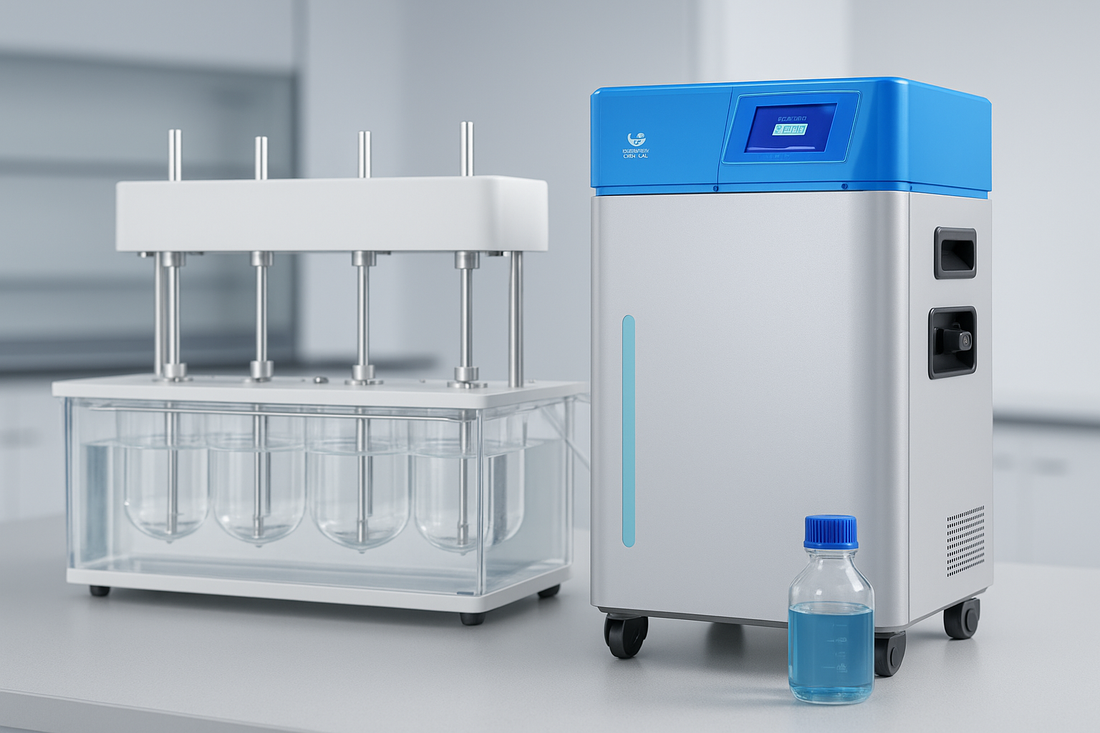
Why Degassing Is Essential Before тестирование растворения — The Role of Vacuum Degassers
Поделиться
Summary: Gas bubbles in растворение media can distort hydrodynamics, cling to dosage forms or paddles, and destabilize the curve—hurting repeatability. A purpose-built вакуумный дегазатор makes media prep faster, more consistent, and easier to defend during audits.
Introduction
In тестирование растворения, media preparation is often underestimated. In reality, dissolved air and microbubbles can drive variability, causing poor repeatability across runs. A вакуумный дегазатор is designed to remove dissolved gases efficiently so your curves remain stable and comparable.
Why degassing matters
- стандарты alignment: Major pharmacopeias call for controlled media preparation to ensure comparable results across labs and batches.
- Bubble interference: Bubbles can adhere to таблетка surfaces or paddles/baskets, altering flow and apparent release rates.
- Better repeatability: With stable, bubble-free media, replicate runs show tighter %RSD and cleaner profiles.
Common industry pain points
- Manual methods lack consistency: Traditional sonication or boiling-and-cooling are operator-dependent and time-consuming.
- Throughput bottlenecks: Preparing multiple vessels can tie up staff and instrumentation.
- Regulatory risk: If media prep doesn’t meet documented expectations, submissions face questions or delays.
HUANGHAI’s раствор: HTQ-1A вакуумный дегазатор
The HTQ-1A вакуумный дегазатор is engineered specifically for растворение media.
- Vacuum-driven degassing: Rapidly removes dissolved gases to minimize bubble formation at тест start.
- High efficiency & repeatability: Delivers consistent results across batches and operators.
- Optimized for растворение workflows: Prepares media that yields smoother, more stable release curves.
Manual vs. vacuum degassing (at a glance)
| Aspect | Manual (boil/sonicate) | HTQ-1A вакуумный дегазатор |
|---|---|---|
| Consistency | Operator-dependent; varies by batch | Process-driven; reproducible |
| Time | Often lengthy (heat/cool cycles) | Fast media turnover |
| Thermal impact | May alter media temperature/composition | Controlled process with minimal thermal stress |
| Audit readiness | Harder to document uniformly | Clear parameters and records |
соответствие & value
- Supports pharmacopeial expectations: Establishes a defendable, documented media-prep step.
- Improves данные reliability: Reduces curve noise and run-to-run variability.
- Lowers hidden costs: Fewer repeats, smoother validation, stronger submissions.
Recommended оборудование
- HTQ-1A вакуумный дегазатор — purpose-built for растворение media prep
FAQs
Q: Do I still need to control media temperature?
Yes. Degassing should be paired with proper temperature control to maintain media specifications before and during the тест.
Q: Can sonication replace vacuum degassing?
Sonication can help, but results are often operator- and setup-dependent. Vacuum degassing provides faster, more uniform outcomes with clearer documentation.
Key takeaway
растворение is a registration-critical assay. By integrating the HTQ-1A вакуумный дегазатор into media prep, labs can avoid bubble interference, stabilize release curves, and improve the repeatability and auditability of their данные.
Frequently Asked Questions
Q: What pharmacopoeial стандарт governs тестирование растворения?
A: тестирование растворения is governed by USP <711> (United States Pharmacopeia), ChP 0931 (Chinese Pharmacopoeia), and Ph.Eur. 2.9.3 (European Pharmacopoeia). All Huanghai RCZ-series растворение testers are designed to comply with USP <711> paddle and basket methods, meeting the ±0.5 rpm speed tolerance and ±0.5°C temperature control требования. For international market access, verify which pharmacopoeia your target regulatory body recognizes.
Q: How many растворение channels do I need for a КК лаб?
A: Channel selection depends on your batch size and тестирование throughput. A 6-channel tester (RCZ-6N) suits small-volume labs running one formulation at a time. An 8-channel tester (RCZ-8A) accommodates USP <711> 6-vessel runs with 2 spares. A 12-channel tester (RCZ-12A) is ideal for high-throughput labs running two products simultaneously. As a rule: choose at minimum 8 channels for routine КК; upgrade to 12 if you have more than 3 active products in КК тестирование. Contact us for pricing.
Q: What is the difference between syringe pump and peristaltic pump in automated sampling?
A: Syringe pumps (used in Huanghai RCZ-QY series) deliver precise, pulsation-free sample withdrawal—critical for viscous media or flow-sensitive APIs. Peristaltic pumps are lower cost but introduce pulsation artifacts that can affect UV absorbance readings in inline detection. For validated methods submitted to regulatory agencies, syringe-pump systems such as the RCZ-QY12 are preferred because they demonstrate superior reproducibility in audit-trail-backed данные.
Q: How often should растворение media be degassed before тестирование?
A: USP <711> recommends degassing растворение media immediately before use to remove dissolved oxygen that can cause bubble formation on таблетка surfaces—leading to false-low растворение results. Best practice: degas each media batch within 30 minutes of тестирование. The HTQ-1A вакуумный дегазатор processes up to 25 liters in a single cycle using vacuum + UV sterilization, eliminating microbial contamination risk. For labs running 8–12 channel testers, a dedicated degasser prevents throughput bottlenecks between runs.
оборудование Certifications & Regulatory соответствие
All Huanghai фармацевтический instruments hold ISO 9001, CE, and relevant GMP certifications.