
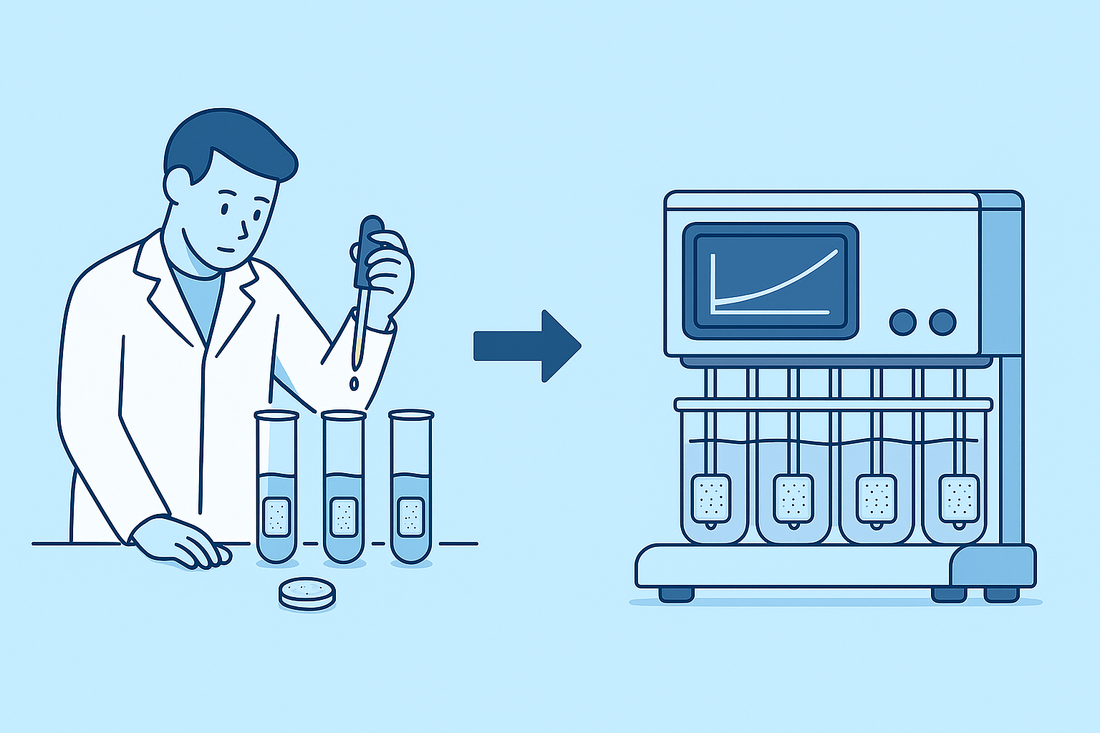
Why Diffusion Testing Matters in Transdermal Drug Development
Share
Summary: As transdermal drug delivery systems expand into patches, solvent-based films, and oral thin films, diffusion testing becomes a critical tool for evaluating release and absorption. The RYJ-12B Diffusion Tester enables accurate, reproducible, and compliant data collection—supporting both R&D and regulatory needs.
Introduction
With the rise of patient-friendly dosage forms such as transdermal patches and oral films, understanding how drugs diffuse through membranes is essential. Diffusion testing simulates in vivo absorption, providing developers with data on release rate, absorption efficiency, and formulation behavior under controlled conditions.
Why diffusion testing is essential
- Dose control: Absorption rate determines plasma concentration profiles.
- R&D guidance: Helps researchers optimize formulations and process parameters.
- Compliance: Many pharmacopeias and regulatory guidelines now require diffusion and permeability data.
Industry pain points
- Manual errors: Traditional diffusion studies rely on manual sampling, prone to inaccuracies.
- Poor repeatability: Unstable test conditions lead to low data comparability.
- Low efficiency: Multi-sample studies are time-consuming, delaying R&D timelines.
HUANGHAI’s solution: RYJ-12B Pharmaceutical Diffusion Tester
The RYJ-12B Diffusion Tester provides a standardized, automated tool for transdermal and oral film R&D:
- Precise temperature control: Maintains stable diffusion conditions throughout the test.
- Automated sampling: Supports long-term continuous testing with minimal operator input.
- Versatility: Compatible with patches, oral films, and other transdermal dosage forms.
Manual vs. automated diffusion testing
| Aspect | Manual Testing | RYJ-12B Diffusion Tester |
|---|---|---|
| Sampling | Manual, prone to operator error | Automated, reproducible |
| Condition stability | Variable, difficult to control | Precisely controlled temperature |
| Throughput | Low, time-consuming | High, supports multiple parallel studies |
| Data quality | Inconsistent, harder to validate | Reliable, audit-ready |
Compliance & value
- Supports efficacy evaluation: Provides quantitative data for transdermal drug delivery.
- Facilitates regulatory approval: Supplies reliable, standardized diffusion data for submissions.
- Reduces risk and timelines: Improves R&D efficiency and decision-making.
Recommended equipment
Key takeaway
Diffusion testing is a cornerstone of modern transdermal formulation development. By adopting the RYJ-12B Diffusion Tester, pharmaceutical teams can ensure high-quality, reproducible data that accelerates drug development and enhances regulatory confidence.
*Designed to meet Class I Div 1 / ATEX explosion-proof standards for safe transdermal solvent handling.
Frequently Asked Questions
Q: What is the regulatory pathway for transdermal patch approval?
A: In the US, transdermal patches are regulated as drug products under FDA 21 CFR Parts 210/211. New patches typically require an ANDA (for generic) or NDA (for novel formulations). Key dossier requirements include in vitro permeation testing (IVPT) data using Franz diffusion cells (USP <724>), comparative adhesion studies, and stability data at ICH conditions. The RYJ-12B Franz Cell Tester generates the IVPT data required for regulatory submissions, using 12-cup vertical diffusion geometry conforming to FDA guidance. Contact us for pricing.
Q: What is in vitro permeation testing (IVPT) and why is it required?
A: IVPT measures the rate and cumulative amount of API that permeates through a membrane (synthetic or excised skin) over time, using a Franz diffusion cell setup. For transdermal patches, IVPT data: (1) establishes in vitro release specifications for batch release; (2) supports bioequivalence claims for generic patches; (3) monitors manufacturing consistency batch-to-batch. FDA's 2022 draft guidance on topical drug bioavailability recommends IVPT as the primary method for many dermatological products. The RYJ-12B supports 12 parallel diffusion cells with temperature-controlled receptor compartments (37°C ± 0.5°C).
Q: How does solvent-based ODF production differ from hot-melt extrusion (HME)?
A: Solvent-based casting (used by Huanghai MJ150/MJ180 systems) dissolves API in a polymer solution, spreads it onto a release liner, and dries off the solvent. This enables higher drug loading, better uniformity for viscous APIs, and broader polymer compatibility. HME processes API and polymers at elevated temperatures—suitable only for thermostable APIs. Solvent-based systems require solvent management infrastructure (Class I/II classified areas, explosion-proof equipment, solvent recovery), while HME avoids this. For most pharmaceutical and nutraceutical ODF applications, solvent-based casting remains the preferred method due to formulation flexibility.
Q: What room classification is required for ODF/transdermal patch manufacturing?
A: For pharmaceutical ODF manufacturing using organic solvents (ethanol, acetone, IPA), the production area requires Class I Division 1 or 2 (NEC) electrical classification (equivalent to ATEX Zone 1 in Europe). Air handling must provide minimum 10 ACH with 100% exhaust (no recirculation), continuous LEL monitoring, and explosion-proof lighting/electrical. Huanghai MJ150/MJ180 machines are designed for installation in classified solvent areas and comply with relevant explosion protection standards. Contact us for site preparation requirements documentation.
For details on our IQ/OQ/PQ certification suite and quality certifications, see our Certifications & Compliance page.
Explore Complete ODF & TDDS Manufacturing Solutions
Huanghai offers end-to-end ODF film production lines — from lab-scale R&D (BY-300A / MJ150-L) to commercial manufacturing (MJ150). GMP-certified and 21 CFR Part 11 compliant.