
Reply within 24 hours · speak with an engineer
Huanghai
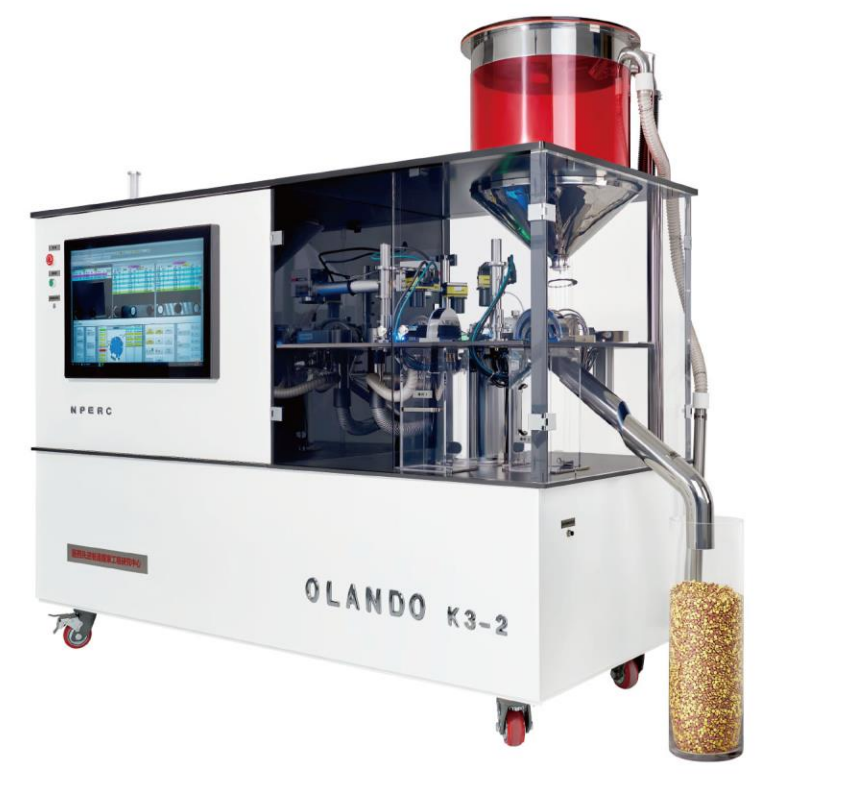
Olando K3-2 Laser Drilling System – Controlled-Release Tablet Micro-Hole Drilling Machine
Olando K3-2 Laser Drilling System – Controlled-Release Tablet Micro-Hole Drilling Machine
Pharmaceutical Laser Tablet Drilling Solutions
The Olando K3-2 Pharmaceutical Laser Drilling System is developed by Huanghai Pharmaceutical Instruments — founded by the core team of China's National Pharmaceutical Engineering Research Center (NPERC) and backed by 97+ registered patents in pharmaceutical manufacturing. Trusted by pharma QC and production teams across 30+ countries for over 40 years.
OLANDO K3-2 Pharmaceutical Laser Drilling System
The Olando K3-2 Pharmaceutical Laser Drilling System is an advanced pharmaceutical testing and processing instrument designed for high-precision laser micro-hole drilling on controlled-release tablets.
This machine supports osmotic drug delivery systems (OROS) by enabling precise, uniform drilling of one or more micro-pores per tablet, essential for regulating drug release profiles.
Description:
The OLANDO K3-2 sets a new benchmark in pharmaceutical manufacturing, offering a seamless combination of high-speed laser drilling, precision inspection, and defect rejection systems. Designed specifically for osmotic pump tablets, this advanced system achieves unparalleled efficiency with a production speed of up to 2,000 tablets per minute. Its compliance with cGMP standards ensures reliability and quality, making it an essential tool for manufacturers aiming to streamline production while maintaining the highest quality standards. With user-friendly operation and integrated networking capabilities, the OLANDO K3-2 empowers pharmaceutical companies to achieve greater productivity and operational excellence.
Key Features:
1. Compliance: Fully adheres to cGMP regulatory requirements, ensuring manufacturing quality and safety.
2. High Speed: Production speed reaches up to 2,000 tablets per minute, with an inspection capacity of up to 2,500 tablets per minute, enabling unparalleled efficiency.
3. Reliability: Dual high-speed cameras provide precise defect detection and real-time rejection for non-conforming tablets.
4. Intelligent Control: One-click operation with real-time alarms and intelligent adjustments based on system feedback, enabling automated handling with minimal human intervention.
5. Ease of Use: Simplified operation interface requires minimal training for operators, ensuring fast adoption and seamless production processes.
6. Networking: Integrated network features allow remote data transmission, system monitoring, and maintenance, offering enhanced control and operational insights.
Technical Parameters:
l Production Capacity 2,000 tablets/min
l Camera Maximum Recognition Time 40ms
l Inspection Speed 2,500 tablets/min
l Qualification Rate 100%
l Vacuum Pressure -0.1 ~ -0.3 MPa
l Compressed Air 0.5 ~ 0.8 MPa
l Laser Power 25W ~ 100W
l Power Supply 220V, 50Hz, 6kW
Want to see it in action?
View Real-World Pharma Applications →Note: Our lab instruments support basic audit trails strictly per USP/ChP standards.
Frequently Asked Questions
Q: How does laser drilling create controlled-release tablets?
A: Laser drilling creates a precise aperture (typically 0.3–1.2mm diameter) in the tablet coating, forming the drug delivery orifice for osmotic pump tablet systems (OROS technology). The osmotic pressure differential between the tablet core and gastrointestinal fluids drives API release through this aperture at a controlled rate. Hole diameter, depth (blind vs. through-hole), and position are critical parameters—variations of ±0.1mm or more can significantly alter release kinetics. The Olando K3-2 maintains ±0.1mm accuracy at 120,000 tablets/hour using closed-loop vision detection.
Q: What is the difference between blind holes and through-holes in osmotic tablets?
A: Through-holes penetrate the entire tablet coating, creating bidirectional flow. Blind holes penetrate only the tablet coat (not the core), creating a single-direction orifice. Most OROS formulations (e.g., Nifedipine CR, Doxazosin Mesylate) use a single blind hole on the coat surface, preserving core integrity while enabling precise osmotic release. Blind holes require tighter laser parameter control because the laser must stop within the coating layer—the Olando K3-2's Siemens PLC-controlled laser delivery system ensures consistent hole depth within ±0.05mm, preventing API core exposure.
Q: What tablet shapes and sizes can the Olando K3-2 process?
A: The Olando K3-2 handles round tablets (bilayer and single-layer) with adjustable feed channel geometry. Standard configurations support tablet diameters from approximately 6mm to 20mm, covering the vast majority of osmotic tablet designs for cardiovascular, CNS, and metabolic indications. The system processes 120,000 tablets/hour (single aperture configuration), equivalent to approximately 2 billion tablets annually on a standard 24/7 production schedule. Contact us with your specific tablet dimensions for configuration confirmation.
Q: Does laser drilling comply with FDA 21 CFR Part 11?
A: The Olando K3-2 Laser Drilling System is designed for cGMP environments and includes Siemens PLC-based process control with audit trail functionality—recording all parameter changes, operator interventions, and batch data in tamper-evident electronic records. This supports compliance with FDA 21 CFR Part 11 and EU Annex 11 data integrity requirements. For full Part 11 compliance, integrate the system's data outputs into a validated manufacturing execution system (MES) or LIMS. Reference customers include Shanghai Modern Pharmaceutical (12 installed units for Nifedipine CR) and Shanghai Xinyi Pharmaceutical (3 units for Doxazosin Mesylate).
Q: What are the ongoing maintenance requirements for laser drilling equipment?
A: Key maintenance items for the Olando K3-2: (1) Laser source service interval: approximately every 10,000 operating hours (roughly 14 months at 24/7 operation); (2) Vision system calibration: recommended every 3–6 months or after any process parameter change; (3) Optics cleaning: weekly inspection, cleaning as needed based on particulate environment. Preventive maintenance should be incorporated into your equipment qualification protocol (IQ/OQ/PQ). Huanghai provides remote diagnostics support and on-site service through our Singapore operations hub. Request our service agreement terms.
Collapsible row
Collapsible row
