How ODF Coating Lines Meet FDA 21 CFR Part 11 Compliance Requirements
Share
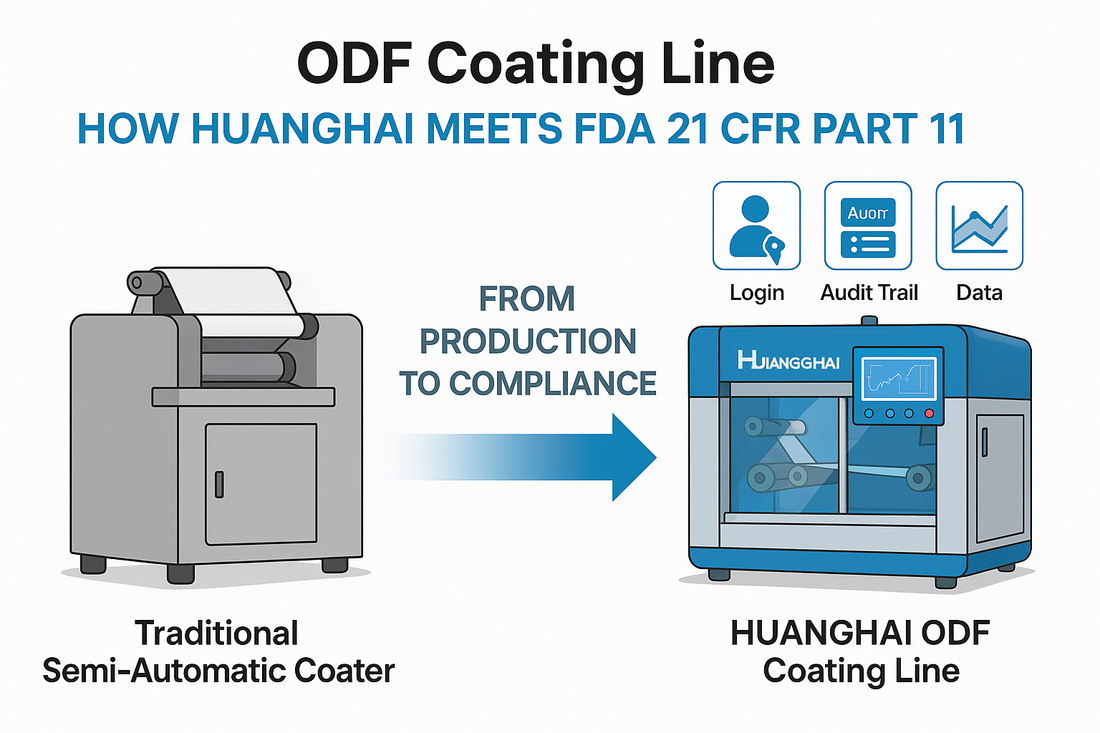
Introduction: As ODF (Oral Dissolvable Film) dosage forms continue expanding in global markets, the compliance adaptability of production equipment has become a major focus for pharmaceutical audits. Traditional food-grade or semi-automatic coating machines often lack compliance modules, making them unsuitable for regulatory submissions. As one of China’s earliest manufacturers of pharma-grade ODF coating systems, HUANGHAI has addressed Part 11 compliance challenges directly from the system design level.
Compliance Risks in ODF Coating Systems
- Manual recordkeeping of parameter changes without audit trails
- No user login or access control management
- Inability to generate electronic records required for registration
- No data backup mechanism, failing to meet U.S. and EU submission standards
What a Compliant ODF System Must Include
- Traceable data logs for solution preparation, coating, and drying parameters
- User actions bound to permission levels and digital signatures
- Audit trail and data export functions
- Connectivity to system logs and real-time operation charts
- Support for IQ/OQ documentation required for regulatory validation
HUANGHAI’s Compliance-Oriented ODF Line Design
- MJ150 / MJ150-L coating systems integrate full Part 11 compliance modules
- Optional features: thickness measurement, drying curve logging, and tension tracking
- Parameter interfaces and export formats aligned with U.S. and EU registration requirements
- Available with Siemens or Panasonic PLC configurations
- Includes OS screenshots, record templates, and validation document samples
*Features Huanghai's exclusive patented hot-air drying technology (Patent No. CN201668734U) ensuring uniform bottom-up heating.
Conclusion
ODF coating systems are not merely production tools — they are part of the regulatory documentation package. Compliance-driven system design is the hidden threshold for competing in the global market. Contact HUANGHAI to request a demo account or sample data template for Part 11-compliant ODF coating systems.
Frequently Asked Questions
Q: What is the difference between an ODF film and a transdermal patch?
A: Oral Dissolving Films (ODF) are placed on or under the tongue and dissolve within seconds to minutes, delivering APIs directly through the oral mucosa or via swallowing. Transdermal patches adhere to the skin and deliver APIs through the dermal layers into systemic circulation over hours to days. Despite different delivery routes, both are manufactured using similar solvent-cast film coating processes. Huanghai's MJ150 ODF machine supports both applications on a single platform with approximately 2 working days of changeover time.
Q: What production output can I expect from a Huanghai ODF machine?
A: The MJ150 produces 20,000 films/hour at commercial scale. The MJ150-L targets R&D and pilot production at 8,000–10,000 films/hour. For fully integrated lines, pair either machine with the MJ180 automatic cutting and packaging system (11,900 films/hr) or the more affordable EZ320 (9,000 films/hr). A complete MJ150 + MJ180 line can produce over 150 million finished pouches annually on a single-shift basis. Contact us for pricing and configuration details.
Q: What drying technology does Huanghai use for ODF production?
A: Huanghai uses patented gradient hot-air drying (Patent CN201668734U), which applies a smooth progressive temperature drop rather than stepwise oven zones used by competitors. This results in more uniform film thickness, reduced edge curl, and better API distribution across the film web. An optional far-infrared heating module adds 20–30% drying efficiency for solvent-based formulations. This patented drying system is one of the key technical advantages that justifies Huanghai's position as the preferred ODF equipment supplier to Sinopharm, Shanghai Pharma, and Fosun Pharma.
Q: What are the GMP requirements for ODF production equipment?
A: ODF manufacturing equipment must comply with cGMP (21 CFR Parts 210/211) for US market products, and equivalent standards (EU GMP Annex 1, ChGMP) for other markets. Key requirements: material contact surfaces must be 316L stainless steel or equivalent; CIP/SIP capability or documented cleaning validation; data integrity controls meeting ALCOA+ principles (audit trails, access control). Huanghai ODF machines meet these standards—all product contact surfaces use pharmaceutical-grade materials, and the control system includes operator access logs and parameter change records. Request our GMP compliance documentation.
Q: Can Huanghai machines produce stripe-coated or multi-formula ODF films?
A: Yes. Huanghai holds a patent for multi-formula stripe coating (Patent CN117323228A), enabling two different API formulations to be applied side-by-side in a single coating pass. This eliminates the need for multiple coating/drying cycles when producing combination-drug ODF products. Competitors require manual multi-layer coating with drying intervals between each formula. This capability is particularly valuable for fixed-dose combination products (e.g., dual-API ODFs for cardiovascular or CNS indications) where coating efficiency directly impacts production economics.
Explore Complete ODF & TDDS Manufacturing Solutions
Huanghai offers end-to-end ODF film production lines — from lab-scale R&D (BY-300A / MJ150-L) to commercial manufacturing (MJ150). GMP-certified and 21 CFR Part 11 compliant.
Equipment Certifications & Regulatory Compliance
All Huanghai pharmaceutical instruments hold ISO 9001, CE, and relevant GMP certifications. ODF production line equipment is fully 21 CFR Part 11 compliant.