
One Device, Multiple Tests: How to Streamline Comprehensive Tablet Quality Control
Share
Summary: Tablet quality directly impacts efficacy, stability, and compliance. Traditionally, weight, thickness, diameter, and hardness testing required multiple instruments and manual records. With a multifunction tablet tester like the SY-6DN, labs can achieve all-in-one, automated, and reliable quality control.
For a full overview of the certifications and compliance standards our equipment meets, see our Certifications & Compliance page.
Introduction
As the most common solid dosage form, tablets demand strict quality oversight. Each parameter—weight, thickness, diameter, hardness—affects dosage accuracy and patient safety. Conventional workflows require multiple instruments, slowing efficiency and raising risks of inconsistency. Multifunction tablet testers consolidate these tasks into one streamlined process.
Why tablet testing matters
- Dosage accuracy: Each tablet must meet tight specifications for weight and thickness to ensure correct drug release.
- Mechanical strength: Hardness and friability affect how tablets endure storage, packaging, and transportation.
- Compliance: Pharmacopeias and GMP demand strict adherence to all critical tablet parameters.
Industry pain points
- Fragmented testing: Multiple instruments are required, data is scattered, and workflows are inefficient.
- Manual recording: Handwritten or manually logged data risks transcription errors and poor traceability.
- Complex validation: Cross-validation of multiple devices increases workload and cost.
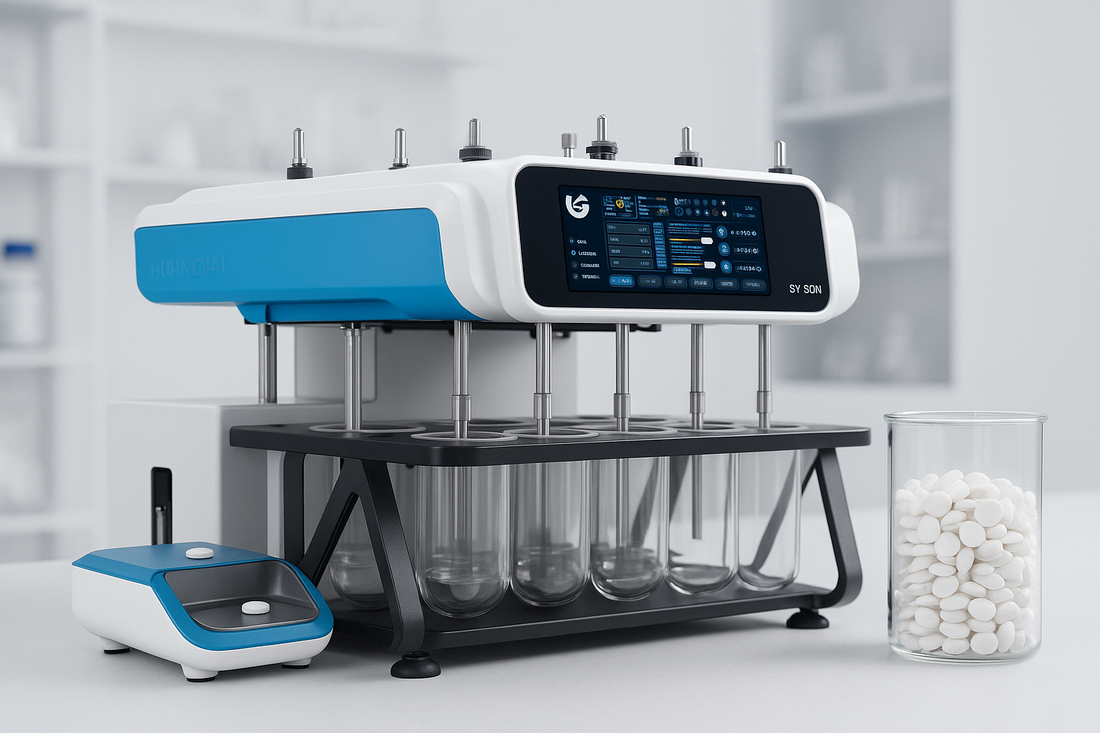
HUANGHAI’s solution: SY-6DN Intelligent Tablet Multi-Purpose Tester
The SY-6DN Multifunction Tablet Tester integrates all key tablet quality assessments in one system:
- All-in-one testing: Weight, thickness, diameter, and hardness completed in a single workflow.
- Automated process: Reduces operator intervention, improves efficiency, and standardizes results.
- Stable, reliable results: Minimizes human error and enhances data consistency across batches.
Comparison: Traditional vs. Multifunction Testing
| Aspect | Traditional Multi-Device Workflow | SY-6DN Multifunction Tester |
|---|---|---|
| Equipment needed | 4 separate instruments | 1 integrated device |
| Efficiency | Low, with manual transfer of samples | High, one-stop measurement |
| Data recording | Manual, risk of error | Automated, audit-ready |
| Validation workload | Multiple device calibrations | Single validation process |
Compliance & value
- Meets pharmacopeia standards: Ensures tablets fulfill all required quality parameters.
- Cost savings: Reduces equipment purchases and ongoing maintenance expenses.
- Efficiency boost: Supports both R&D labs and production QC environments with streamlined workflows.
Recommended equipment
Key takeaway
Modern pharmaceutical QC requires both accuracy and efficiency. By consolidating multiple tests into one workflow, the SY-6DN Multifunction Tablet Tester simplifies tablet quality control, lowers costs, and ensures reliable compliance with pharmacopeial requirements.
Data Integrity Note: Our lab instruments (e.g., LB-3D, SY-6DN, RCZ series) support basic audit trails strictly per USP/ChP standards. 21 CFR Part 11 is not applicable to these lab instruments — they support basic audit trails per USP/ChP standards.
Frequently Asked Questions
Q: What is the difference between FDA 21 CFR Part 11 and EU Annex 11?
A: Both regulations govern electronic records and electronic signatures (ERES) in pharmaceutical manufacturing, but with different scope: FDA 21 CFR Part 11 applies to US-regulated facilities and is prescriptive about technical controls (audit trails, access control, system validation). EU GMP Annex 11 is risk-based and less prescriptive—it emphasizes validation, data integrity, and business continuity. Key operational difference: EU Annex 11 requires a more detailed risk assessment before and during computerized system use, while Part 11 specifies minimum technical requirements. For global market access, instrument and software systems should satisfy both frameworks simultaneously.
Q: What are the ALCOA+ principles and how do they apply to lab instruments?
A: ALCOA+ stands for: Attributable, Legible, Contemporaneous, Original, Accurate—plus Complete, Consistent, Enduring, and Available. For pharmaceutical lab instruments: Attributable = each data entry/change linked to a specific operator login; Contemporaneous = data recorded at the time of testing, not reconstructed; Original = raw data preserved unmodified; Accurate = calibration and maintenance records substantiate measurement accuracy. Huanghai intelligent instruments (RCZ-8N, LB-3D, YPD-350N, SY-6DN) include operator login, timestamped audit trails, and parameter lockout to support ALCOA+ compliance. For full compliance, pair with a validated LIMS.
Q: How should IQ/OQ/PQ qualification be conducted for pharmaceutical testing instruments?
A: Three-phase qualification: IQ (Installation Qualification) verifies the instrument is installed per manufacturer specifications (utilities, environment, documentation). OQ (Operational Qualification) verifies the instrument operates within specified parameters across its full operating range—for dissolution testers this includes temperature control (37°C ± 0.5°C), paddle/basket speed (±4% of specified RPM per USP), and vessel volume accuracy. PQ (Performance Qualification) verifies consistent performance over time under actual use conditions. Huanghai provides IQ/OQ protocols upon request for all instrument models. Factory Acceptance Testing (FAT) documentation is available for ODF and laser drilling equipment.
Q: What data backup and disaster recovery is required for GMP electronic records?
A: FDA 21 CFR Part 11 and EU Annex 11 require that electronic records remain retrievable for the duration of record retention periods (typically 1 year after product expiry, minimum 2 years post-batch release for most products). Best practice: implement automated daily backups to an off-site or cloud location, with quarterly restoration testing. For instrument-level data, store primary records on a validated LIMS or network server rather than relying on instrument internal memory. A documented disaster recovery plan (DRP) with defined RTO (Recovery Time Objective) and RPO (Recovery Point Objective) is expected in regulatory inspections. Contact us to discuss instrument data export and LIMS integration options.