
Olando K3-2 vs Other Brands: The Practical Choice for GMP Lines
Share
When selecting a laser tablet drilling system for osmotic tablets (e.g., Metformin, Nifedipine), real-world performance beats brochure numbers. This article compares our Olando K3-2 with other international brand solutions from the angles that matter most on a GMP floor: operation, cleaning, throughput, compliance, total cost, and service response.
For a full overview of the certifications and compliance standards our equipment meets, see our Certifications & Compliance page.
Why this comparison matters
- More than peak speed: Operators, cleaning/changeover, compliance, and response time drive OEE and time-to-validation.
- GMP realities: Space is tight; digital records must pass audits. A compact, Part 11–ready system starts up faster.
- ROI focus: If your target is up to 100k–120k tablets/hour, the right balance of usability and cost wins.
Key Differences at a Glance
| Dimension | Olando K3-2 | Other International Brands | What it means on the line |
|---|---|---|---|
| Operation | Simple HMI, quick parameter recall; fast start/stop | Often more steps and deeper menus | Shorter training & fewer operator errors |
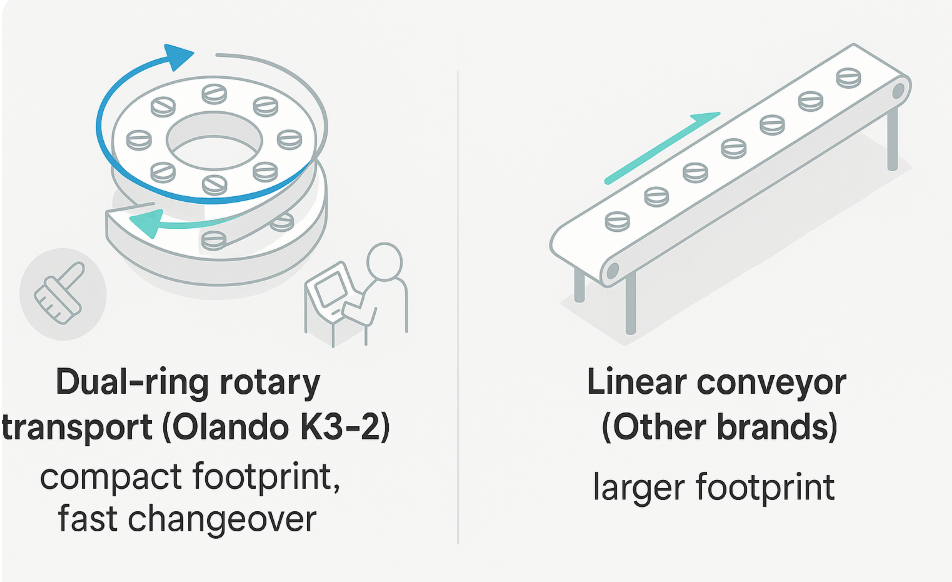
| Cleaning & Changeover | Dual-ring rotary transport, compact path; easier daily cleaning & batch change | Linear conveyor & longer footprint mean larger cleaning coverage | Faster changeover = higher effective throughput (OEE) |
| Throughput | Up to 120,000 tablets/hour | Some brands advertise up to ~140,000/h | Both cover 100k–120k/h targets; others may edge higher on peak |
| Compliance | 21 CFR Part 11–ready: user access, e-signatures, audit trail; IQ/OQ documentation available | Typically similar claims | Audit-ready data integrity for regulated markets |
| Footprint | Compact layout thanks to dual-ring transport | Longer linear lines | Better space utilization in GMP rooms |
| Total Cost & ROI | More competitive overall budget at comparable configurations; target ≤ 3-month delivery with on-site install & training | Higher overall investment is common | Faster ramp-up and payback |
| Service Response | < 24-hour response (remote/on-site coordination) | Often longer response times (customers commonly report ~2 days) | Lower downtime risk at a critical process node |
What both classes can do
- Dual-camera inspection with reject mechanisms for defective tablets.
- GMP-aligned digital records and support for 21 CFR Part 11 features.
- Commercial-scale deployment in osmotic tablet production.
Selection guidance
- Space-constrained GMP rooms, fast start-up, and easy maintenance: K3-2’s compact, dual-ring design and quick cleaning/changeover are highly advantageous.
- Pursuing absolute peak speed: Some international brands may publish a slightly higher ceiling; weigh footprint, budget, and response time trade-offs.
- Audit-led projects: Request Part 11 features (user roles, e-signatures, audit trail) and IQ/OQ templates from any vendor—K3-2 provides both.
Engineering highlights (K3-2)
- Transport: Dual-ring rotary tablet transport for compact footprint and stable high throughput.
- Vision & Lighting: Cognex vision, CCS lighting; real-time inspection and reject.
- Control: Linux-based upper system; PLC options include Panasonic or Siemens upon request.
- Compliance: 21 CFR Part 11 support (user access control, electronic signatures, audit trail); IQ/OQ documentation available.
- Support: On-site international installation and 1-week training; < 24-hour support response.
Procurement & validation checklist
- Part 11: user roles, e-signature, audit trail; sample logs/screenshots.
- IQ/OQ package readiness; SOPs and training materials.
- Cleaning/changeover: dead-spot access, typical time for size/recipe change.
- Throughput target: stable 100k–120k/h or chasing higher peak?
- MES/EBR connectivity and export formats for traceability.
- Service SLA: response time, spare parts lead time, preventive maintenance plan.
See the machine
Product page: Olando K3-2 Pharmaceutical Laser Drilling System
Conclusion
If your goal is a validated, stable 100k–120k/h line with faster start-up, the combination of simpler operation, easier cleaning/changeover, compact footprint, Part 11 readiness, and a more competitive overall budget makes K3-2 a practical choice. Add the < 24-hour response time, and your risk of prolonged downtime at this critical process node goes down significantly.
Ask us for a one-page comparison sheet, audit-trail samples, and a cleaning/changeover checklist tailored to your product format.
Frequently Asked Questions
Q: How does laser drilling create controlled-release tablets?
A: Laser drilling creates a precise aperture (typically 0.3–1.2mm diameter) in the tablet coating, forming the drug delivery orifice for osmotic pump tablet systems (OROS technology). The osmotic pressure differential between the tablet core and gastrointestinal fluids drives API release through this aperture at a controlled rate. Hole diameter, depth (blind vs. through-hole), and position are critical parameters—variations of ±0.1mm or more can significantly alter release kinetics. The Olando K3-2 maintains ±0.1mm accuracy at 120,000 tablets/hour using closed-loop vision detection.
Q: What is the difference between blind holes and through-holes in osmotic tablets?
A: Through-holes penetrate the entire tablet coating, creating bidirectional flow. Blind holes penetrate only the tablet coat (not the core), creating a single-direction orifice. Most OROS formulations (e.g., Nifedipine CR, Doxazosin Mesylate) use a single blind hole on the coat surface, preserving core integrity while enabling precise osmotic release. Blind holes require tighter laser parameter control because the laser must stop within the coating layer—the Olando K3-2's Siemens PLC-controlled laser delivery system ensures consistent hole depth within ±0.05mm, preventing API core exposure.
Q: What tablet shapes and sizes can the Olando K3-2 process?
A: The Olando K3-2 handles round tablets (bilayer and single-layer) with adjustable feed channel geometry. Standard configurations support tablet diameters from approximately 6mm to 20mm, covering the vast majority of osmotic tablet designs for cardiovascular, CNS, and metabolic indications. The system processes 120,000 tablets/hour (single aperture configuration), equivalent to approximately 2 billion tablets annually on a standard 24/7 production schedule. Contact us with your specific tablet dimensions for configuration confirmation.
Q: Does laser drilling comply with FDA 21 CFR Part 11?
A: The Olando K3-2 Laser Drilling System is designed for cGMP environments and includes Siemens PLC-based process control with audit trail functionality—recording all parameter changes, operator interventions, and batch data in tamper-evident electronic records. This supports compliance with FDA 21 CFR Part 11 and EU Annex 11 data integrity requirements. For full Part 11 compliance, integrate the system's data outputs into a validated manufacturing execution system (MES) or LIMS. Reference customers include Shanghai Modern Pharmaceutical (12 installed units for Nifedipine CR) and Shanghai Xinyi Pharmaceutical (3 units for Doxazosin Mesylate).
Q: What are the ongoing maintenance requirements for laser drilling equipment?
A: Key maintenance items for the Olando K3-2: (1) Laser source service interval: approximately every 10,000 operating hours (roughly 14 months at 24/7 operation); (2) Vision system calibration: recommended every 3–6 months or after any process parameter change; (3) Optics cleaning: weekly inspection, cleaning as needed based on particulate environment. Preventive maintenance should be incorporated into your equipment qualification protocol (IQ/OQ/PQ). Huanghai provides remote diagnostics support and on-site service through our Singapore operations hub. Request our service agreement terms.
Related guides
- Laser Drilling for Osmotic Pump Tablets: Orientation & Closed Loop
- Quality Control for Laser-Drilled Osmotic Tablets: SPC on Pore Size, Position, and Automatic Rejection
- Patent-Backed Laser Drilling for Two-Chamber Osmotic Tablets: Problems Solved, Advantages Secured
Explore all Pharmaceutical Laser Drilling Systems →