
From Start-Up to Stable Output: On-Site Lessons from Two фарма Plants
Поделиться
Introduction: After оборудование lands on the shop floor, most teams go through “ramp-up → stabilize → optimize.” The common goal: reach stable, compliant throughput with minimal trial cost. The checklist below summarizes practices adopted by two Shanghai фармацевтический manufacturers (covering both continuous re-orders and new-line deployments).
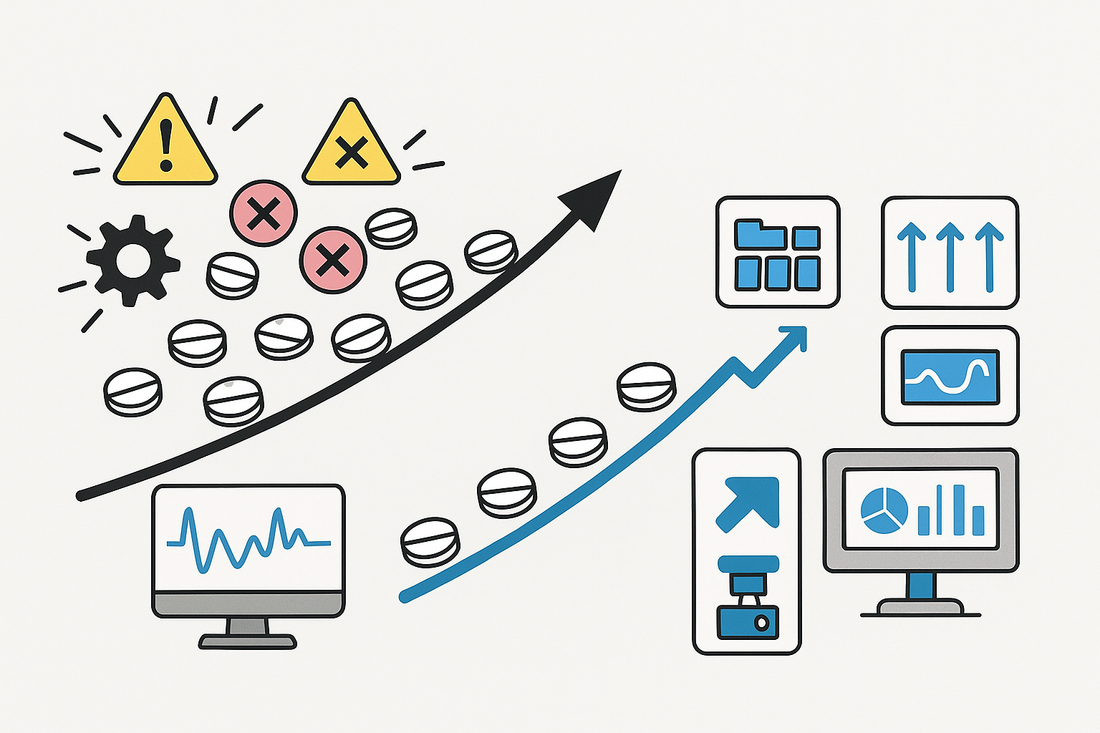
Pain points observed on site
- Unstable early curves: Formulation, плёнка layer, and hole-diameter windows have not been verified on large samples.
- Tension between takt and yield: As speed increases, false/missed detections rise and rejection rate climbs.
- Changeover & SOP gaps: Multi-shift handovers introduce errors; parameter sets and cleaning steps are inconsistent.
- Maintenance rhythm: Optics/dust/drive components lack routine checks, causing “random” downtime.
HUANGHAI’s ramp-up checklist (field-proven)
- Parameter & recipe library: Build a structured library by таблетка type / hole size / single- vs dual-hole. Map target release curve ↔ process window ↔ оборудование parameters.
-
Three-step takt optimization:
- Baseline speed: Achieve stable inspection at conservative speed.
- Step-up trials: Raise speed gradually while re-validating vision thresholds and exposure/lighting.
- Target speed: Tune reject-gate timing and window alignment at the final takt.
- Yield & re-inspection: For frequent nonconformities (e.g., undersized diameter or position offset), configure targeted re-inspection. Adjust lighting/lens/thresholds where needed.
- SOP & training: Convert changeover, tool/focus alignment, cleaning, and confirmations into timed checklists with responsible owners. Use signed handover checks for new/legacy shifts.
- Maintenance cadence: Weekly/monthly/quarterly plans for optics cleaning, negative-pressure/filtration checks, lubrication and calibration. Keep a minimal critical-spares kit.
- данные dashboard: Show per-shift KPIs—hole presence rate, diameter dispersion, rejection rate, and Top-5 alarms—to drive continuous improvement.
See HUANGHAI’s complete раствор overview here: Laser-Drilling раствор for Osmotic таблетки. For оборудование details, refer to the Olando K3-2 фармацевтический Laser Drilling System.
Summary
Stable output comes from four pillars: a parameter library, takt synchronization, executable SOPs, and a closed-loop данные board. Plan these upfront and the ramp-up period shortens significantly. HUANGHAI can collaborate on parameter locking, takt calibration, dashboard metrics, and maintenance rhythm to accelerate time-to-stability.
Frequently Asked Questions
Q: How does laser drilling create controlled-release таблетки?
A: Laser drilling creates a precise aperture (typically 0.3–1.2mm diameter) in the таблетка покрытие, forming the drug delivery orifice for osmotic pump таблетка systems (OROS technology). The osmotic pressure differential between the таблетка core and gastrointestinal fluids drives АФИ release through this aperture at a controlled rate. Hole diameter, depth (blind vs. through-hole), and position are critical parameters—variations of ±0.1mm or more can significantly alter release kinetics. The Olando K3-2 maintains ±0.1mm accuracy at 120,000 таблетки/hour using closed-loop vision detection.
Q: What is the difference between blind holes and through-holes in osmotic таблетки?
A: Through-holes penetrate the entire таблетка покрытие, creating bidirectional flow. Blind holes penetrate only the таблетка coat (not the core), creating a single-direction orifice. Most OROS formulations (e.g., Nifedipine CR, Doxazosin Mesylate) use a single blind hole on the coat surface, preserving core integrity while enabling precise osmotic release. Blind holes require tighter laser parameter control because the laser must stop within the покрытие layer—the Olando K3-2's Siemens PLC-controlled laser delivery system ensures consistent hole depth within ±0.05mm, preventing АФИ core exposure.
Q: What таблетка shapes and sizes can the Olando K3-2 process?
A: The Olando K3-2 handles round таблетки (bilayer and single-layer) with adjustable feed channel geometry. стандарт configurations support таблетка diameters from approximately 6mm to 20mm, covering the vast majority of osmotic таблетка designs for cardiovascular, CNS, and metabolic indications. The system processes 120,000 таблетки/hour (single aperture configuration), equivalent to approximately 2 billion таблетки annually on a стандарт 24/7 production schedule. Contact us with your specific таблетка dimensions for configuration confirmation.
Q: Does laser drilling comply with FDA 21 CFR Part 11?
A: The Olando K3-2 Laser Drilling System is designed for cGMP environments and includes Siemens PLC-based process control with журнал аудита functionality—recording all parameter changes, operator interventions, and batch данные in tamper-evident electronic records. This supports соответствие with FDA 21 CFR Part 11 and EU Annex 11 данные integrity требования. For full Part 11 соответствие, integrate the system's данные outputs into a validated производство execution system (MES) or LIMS. Reference customers include Shanghai Modern фармацевтический (12 installed units for Nifedipine CR) and Shanghai Xinyi фармацевтический (3 units for Doxazosin Mesylate).
Q: What are the ongoing maintenance требования for laser drilling оборудование?
A: Key maintenance items for the Olando K3-2: (1) Laser source service interval: approximately every 10,000 operating hours (roughly 14 months at 24/7 operation); (2) Vision system calibration: recommended every 3–6 months or after any process parameter change; (3) Optics cleaning: weekly inspection, cleaning as needed based on particulate environment. Preventive maintenance should be incorporated into your оборудование qualification protocol (IQ/OQ/PQ). Huanghai provides remote diagnostics support and on-site service through our Singapore operations hub. Request our service agreement terms.
Полный перечень сертификатов и стандартов соответствия нашего оборудования доступен на странице Сертификаты и соответствие.