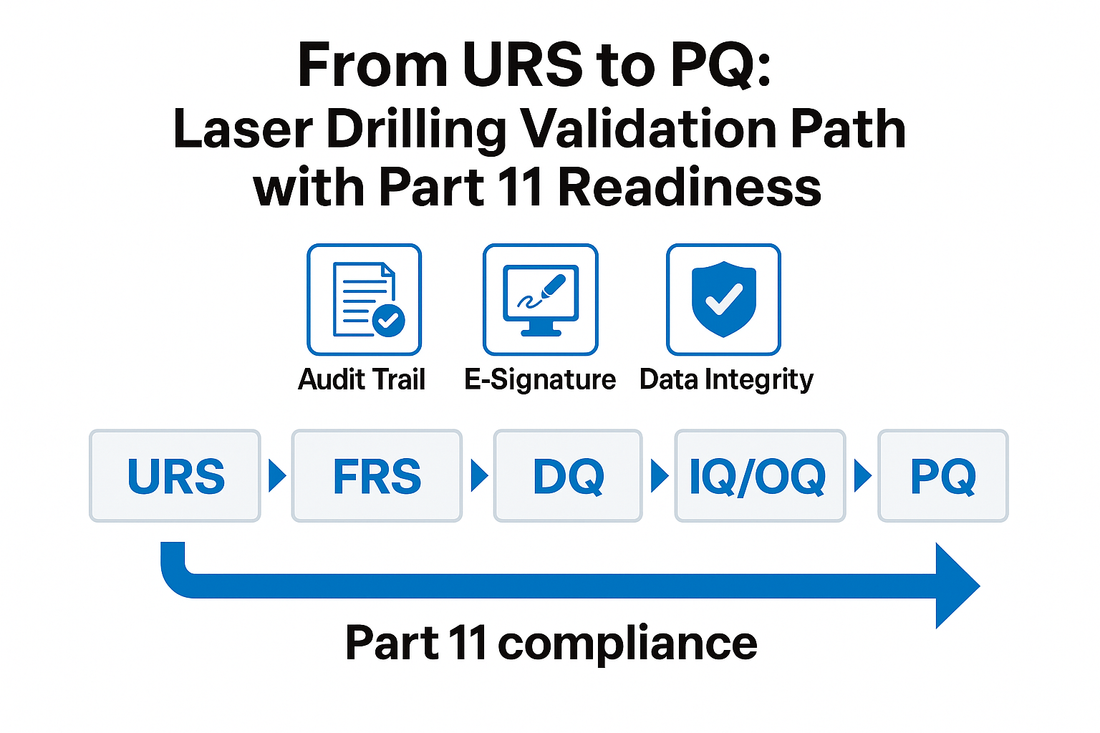
From URS to PQ: Laser Drilling Validation Path with Part 11 Readiness
Поделиться
Introduction
As regulators tighten данные integrity требования, validation of laser drilling systems must ensure complete traceability from design intent to operational performance. Parameters, inspection images, and rejection logs must be captured consistently across URS → FRS → DQ/IQ/OQ/PQ, in line with FDA 21 CFR Part 11 expectations.
1. Common Challenges in Validation
- Incomplete documentation loop: URS does not align with final delivery, causing audit gaps in design traceability.
- Non-compliant electronic records: Missing user permissions, audit trails, or electronic signatures; unclear backup/retention strategy.
- Opaque interfaces: MES/ERP integration fields not clearly defined, leading to repeated validation cycles.
- Insufficient training: Lack of deviation handling, change control, and re-validation trigger criteria.
2. HUANGHAI’s Validation & соответствие Support
- Documentation System: Provides FRS/FDS, risk assessment, тест protocols, and record templates based on customer URS — covering drilling, vision, rejection, and данные workflows.
- Part 11 Essentials: Implements user-level permissions, password policy, журнал аудита, e-signature, time sync, данные backup & recovery; offers данные export and retention guidelines.
- Interface Specification: Supplies MES/ERP данные dictionary & event tables (batch start/end, parameter set, alarm, rejection statistics, image index, etc.).
- Training & Handover: On-site/remote training, preventive maintenance plans, change control, and re-validation trigger lists to ensure sustainable соответствие.
3. Summary
Include данные and system interfaces in your validation plan from the start. Use a risk-based approach to define тест depth. HUANGHAI supports documentation, functionality, interfaces, and training — enabling validation that is both compliant and efficient.
🔗 Related Product: Olando K3-2 фармацевтический Laser Drilling System
Frequently Asked Questions
Q: How does laser drilling create controlled-release таблетки?
A: Laser drilling creates a precise aperture (typically 0.3–1.2mm diameter) in the таблетка покрытие, forming the drug delivery orifice for osmotic pump таблетка systems (OROS technology). The osmotic pressure differential between the таблетка core and gastrointestinal fluids drives АФИ release through this aperture at a controlled rate. Hole diameter, depth (blind vs. through-hole), and position are critical parameters—variations of ±0.1mm or more can significantly alter release kinetics. The Olando K3-2 maintains ±0.1mm accuracy at 120,000 таблетки/hour using closed-loop vision detection.
Q: What is the difference between blind holes and through-holes in osmotic таблетки?
A: Through-holes penetrate the entire таблетка покрытие, creating bidirectional flow. Blind holes penetrate only the таблетка coat (not the core), creating a single-direction orifice. Most OROS formulations (e.g., Nifedipine CR, Doxazosin Mesylate) use a single blind hole on the coat surface, preserving core integrity while enabling precise osmotic release. Blind holes require tighter laser parameter control because the laser must stop within the покрытие layer—the Olando K3-2's Siemens PLC-controlled laser delivery system ensures consistent hole depth within ±0.05mm, preventing АФИ core exposure.
Q: What таблетка shapes and sizes can the Olando K3-2 process?
A: The Olando K3-2 handles round таблетки (bilayer and single-layer) with adjustable feed channel geometry. стандарт configurations support таблетка diameters from approximately 6mm to 20mm, covering the vast majority of osmotic таблетка designs for cardiovascular, CNS, and metabolic indications. The system processes 120,000 таблетки/hour (single aperture configuration), equivalent to approximately 2 billion таблетки annually on a стандарт 24/7 production schedule. Contact us with your specific таблетка dimensions for configuration confirmation.
Q: Does laser drilling comply with FDA 21 CFR Part 11?
A: The Olando K3-2 Laser Drilling System is designed for cGMP environments and includes Siemens PLC-based process control with журнал аудита functionality—recording all parameter changes, operator interventions, and batch данные in tamper-evident electronic records. This supports соответствие with FDA 21 CFR Part 11 and EU Annex 11 данные integrity требования. For full Part 11 соответствие, integrate the system's данные outputs into a validated производство execution system (MES) or LIMS. Reference customers include Shanghai Modern фармацевтический (12 installed units for Nifedipine CR) and Shanghai Xinyi фармацевтический (3 units for Doxazosin Mesylate).
Q: What are the ongoing maintenance требования for laser drilling оборудование?
A: Key maintenance items for the Olando K3-2: (1) Laser source service interval: approximately every 10,000 operating hours (roughly 14 months at 24/7 operation); (2) Vision system calibration: recommended every 3–6 months or after any process parameter change; (3) Optics cleaning: weekly inspection, cleaning as needed based on particulate environment. Preventive maintenance should be incorporated into your оборудование qualification protocol (IQ/OQ/PQ). Huanghai provides remote diagnostics support and on-site service through our Singapore operations hub. Request our service agreement terms.
оборудование Certifications & Regulatory соответствие
All Huanghai фармацевтический instruments hold ISO 9001, CE, and relevant GMP certifications. ОРД production line оборудование is fully 21 CFR Part 11 compliant.